Showing posts with label Substance Abuse. Show all posts

Sunday, April 17, 2011

SUNDAY SOAPBOX: The 13th Step, Sexual Abuse in 12 Step Programs

"Same shit, verbatim" my friend Miranda says, and it's the truth.

It's one of those ongoing problems that just doesn't seem to want to go away. There are a lot of descriptions for it: sexual harassment, predatory behavior, sex addiction, etc., etc. It's nothing new, and never pretty, but there is something particularly despicable about it when it goes on in places we associate with safety. like churches and schools.

And 12th Step programs, where it's known as the 13th Step.

There are a million bad recovery jokes about it, but sadly, the issue itself is not funny. This week I have heard from three females, two adults and one 16 year old girl, all of whom had been subjected to sexual harassment at Narcotics Anonymous meetings.

I have heard about a male who asks for phone numbers, then takes a list intended for females and begins to mass text the women, saying he needs someone to talk to. He doesn't even have the imagination to vary the message.

As my friend says, "Same shit, verbatim."

Invariably someone says that it isn't just a male-harasses-female issue, but to be honest, I could count the number of female-harassing-males incidents I have encountered on one hand and have fingers left over.

So let's be clear: issues of sexual trauma and abuse abound in 12 Step programs. Predatory behavior is always destructive, in this setting, it downright lethal. Everyone deserves a chance to recover from addiction, and not to be driven away from a source of help and comfort by sexual harassment and abuse.

I took the Roman Catholic Church, of which I used to be a devout member, sternly to task for ignoring, aiding and abetting sexual abuse.

I will do the same to the 12 Step programs, which I love with all my heart. I refuse to be part of covering up sexually predatory behavior because of "anonymity" any more that I would condone it under the guise of "the greater good" in the church. If you engage in predatory behaviors in N.A. and A.A or any other 12 Step program, as far as I am concerned, you have forfeited your right to anonymity, and I will deal with you as I would any other sexual predator.

I will not let you destroy lives in a program that exists to save them.

I will not let you kill my program.

I sincerely hope I am not the only recovering person who feels this way.
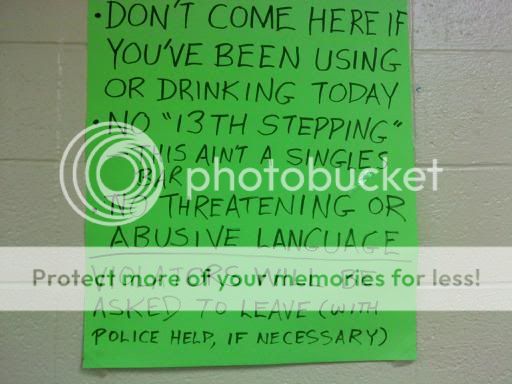
(anyone who has survived 12 Step Sexual Abuse, or is being abused, contact Ken Williams in complete confidence at kenwilliamscac@gmail.com, or call or text Ken Williams' Recovery at 484 431 2931)


Sunday, October 10, 2010

Rough Justice

Drug Court seemed like such a good idea when it came to my little corner of the world.
It took me, and a lot of other people-helper types, by surprise. Delaware County hasn't been known, to put it very mildly, for its enlightened attitudes toward issues of mental health and substance use disorders. But it was a start, right?

The fundamental concept behind Drug Court is that the court acts as a supercharged big brother, empowered to mandate everything from incarceration to rehab, utilizing an in-your-face approach in weekly sessions to make sure that participants are staying on the straight and narrow, as well as compliant with the treatment programs with which they are involved. 

Great idea, isn't it?

Sure, when everything goes smoothly. Which it rarely does in the world of substance use disorders. Then we end up with messes like this:

A 19 year old male is picked up with three of his friends in a parked car, smoking pot. A cop sees one of them throw a blunt out the window, and they are busted. The boy holding the stash gives it up, and the sharp District Attorney realizes that the way the pot is packaged, in little plastic envelopes or "dime bags" means that he can be charged with trafficking, even though the amount is minimal and there is absolutely no indication of any drug dealing going on.

The 19 year old is terrified; a trafficking charge is a felony and carries serious jail time. He doesn't want to go to jail. He pleads guilty to a felony in order to get into drug court and avoid jail time. 

Happy ending?  Not.

Anyone who has worked with young people, knows exactly what I am going to say next. Treatment of young adults is complicated. They struggle, they fail. They take two steps forward and one step back. 

But, you'd figure that a well-trained drug court with a addiction counselor as an advisor would know that and plan accordingly, right?

Wrong. Oh they cut him a couple of breaks, alright. But when that didn't work, the judge decided he had enough, and sent the boy to jail.

To the State Penitentiary at Graterford, for a year and a half.

Six months longer than the District Attorney asked for. 

So, the end result is a boy who is not even legal drinking age is doing a year and a half in a maximum security state prison for smoking pot with his buddies in a parked car.

Enlightened, isn't it?

Sunday, January 17, 2010

Resolutions

New York Times Square New year celebrations in...Image via Wikipedia
Remember those New Years' Resolutions?

How are you doing with them? The promise to stop smoking at midnight on New Years Eve?

The resolution to exercise every day?

The commitments to walk more, eat less, and clean all that stuff out of the hall closet?

Chances are, not a lot has happened. It's understandable, because the very behaviors we often seem to be the most eager to be rid of are the ones actuallly most diffucult to change. Why is this? Because as bright as we van be about some things, we remain downright stupid about how people change.

If it was as easy as making a resolution and setting a date, then change would be simple and easy. We'd say, here's what I want to change, and have at it. That's how we like to think about change. Every family has a story about Uncle Joe who drank for twenty years and then saw the light. That was that, never touched another drop. Or Aunt Lucille, who ran on Newports and coffee for forty years, then had that cancer scare and never touched either, just like that!

That's how we tend to think about change. And that's part of what makes change difficult. It's a process, not an event. The Uncle Joe and Aunt Lucille stories are impressive, and often true. They are inspiring, but do very little to suggest a model for change. and the reason may be genetic. This link explains more.

No kidding, those pesky genes may well be playing a part in the process of change. It appears, according to some current research, that scientists have linked genetics to difficulty stopping cigarette smoking. It seems that some of us have "easy" genes and some of us have "tough" genes. If you are blessed with easy genes, then guess what? You quit smoking just like Aunt Lucille. If you have "tough" genes, though, quitting is likely not to be a walk in the park. You'll try, fail, have some success, try again, and so forth. Eventually, you'll quit.

I say that with a degree of confidence, because I quit smoking almost three years ago, and I was no Aunt Lucille smoker. I smoked in earnestr for over 40 years. My first serious attempt to stop smoking was in 1977 and I finally made it to non-smoker in 2007. None of this is delivered so that I can pat myself on the back, or eexpect you to. If anything, it indicates that I am a very slow learner with some seriously stubborn genes. But it does say something about a different way of looking at change.
  • We think about change before we change. It took a lot of thinking about being a non-smoker before I was ready to try it, even for a day.
  • Support counts; shame sucks. Having people in your corner who want to see you change is great. You can tell who they are because they always say, I know you can do this.  If they don't, and especially if they talk a lot about what you "should" do and "should" have done, watch out. Especially if the person telling you what you "should have done" is you!
  • Perseverance usually trumps everything else. If you keep trying, you will achieve your goal. It's that simple. It's no coincidence that the greatest fellowships for helping people tto change use the motto "One Day At A Time." That's a way off keeping things very simple: just keep trying to do your best every day.
And if you do, you will change. I promise!
Reblog this post [with Zemanta]

Wednesday, September 2, 2009

The Sacred And The Profane: Spirituality in Recovery

I was having a cup of coffee the other day with Grateful John. He said that he was angry with his daughter over her arrest for drunk driving, and described what options he had. It went something like this:

"I wanted to bust her blanking face in and slap some blanking sense into her but my blanking conscience kicked in and told me to call my blanking sponsor. I did, and he said to pray on it. blanking pray? I'll blank pray, I said. But I did, and I asked my Higher Power to take the whole thing over because I couldn't blanking deal with it. I had to turn it the blank# over to God as I understand Him and get out of the blanking way. I'm not ready to deal with that, I look at her and see myself, my own blanked up excuses and I get angry, not at her. At me for being a blanked up father because of this blanking illness. Thank God I called my Sponsor"

Only he didn't really say blank

I am not thinking that Grateful John is likely to be helping the Pope draft his Christmas Encyclical this year, but I do believe that his faith and trust in God, and his willingness to do God's will, are as strong and valid and true as any more pious, and less profane individual's.

This is a good example of the way that the sacred and the profane co-exist in the 12 Step Programs. As my Uncle Jerry the Bartender, sober over 30 years in AA, once said, "a lot of us aren't exactly Choirboys when we come in."

It's true. It's also true that very few addicts and alcoholics seek out the 12 Step programs because they feel a sudden need for spiritual growth. Addicted people go to meetings out of fear and desperation. Sometimes desperation for something that will work and fear that they have found it. The illness of addiction so utterly takes over an addict's life that in a pathetically perverse paradox, the thing destroying them (the addiction) feels like the only thing that makes life bearable. To threaten the addiction with recovery is like threatening life itself, and every corrupted survival mechanism kicks in. Addicts come to their first 12 Step meetings in fight or flight mode.

And yet, there they are, usually hanging right on the wall, or in case someone missed them, read out loud at the beginning of the meeting:

The Twelve Steps of Narcotics Anonymous
1. We admitted we were powerless over our addiction, that our lives had become unmanageable.
2. We came to believe that a Power greater than ourselves could restore us to sanity.
3. We made a decision to turn our will and our lives over to the care of God as we understood Him.
4. We made a searching and fearless moral inventory of ourselves.
5. We admitted to God, to ourselves, and to another human being the exact nature of our wrongs.
6. We were entirely ready to have God remove all these defects of character.
7. We humbly asked Him to remove our shortcomings.
8. We made a list of all persons we had harmed, and became willing to make amends to them all.
9. We made direct amends to such people wherever possible, except when to do so would injure them or others.
10. We continued to take personal inventory and when we were wrong promptly admitted it.
11. We sought through prayer and meditation to improve our conscious contact with God as we understood Him, praying only for knowledge of His will for us and the power to carry that out.
12. Having had a spiritual awakening as a result of these steps, we tried to carry this message to addicts, and to practice these principles in all our affairs.

It doesn't leave a lot of room for doubt that this is a spiritual program with a Higher Power at the heart of it.

So, how does the world of the active addict and the world of the spirit co-exist?

Pretty Good, actually. Ask Grateful John why he's grateful?

(More to come)

Monday, August 24, 2009

Do The Right Thing.

Acceptance and Commitment TherapyImage by Leonard John Matthews via Flickr

Sometimes, you just have to do what's right.

A couple of years ago a friend of mine, Stacey Gill, approached me with an idea for a group for kids from families with substance abuse issues. I was skeptical at first, but eventually realized the importance of doing something to help some kids before they got into trouble.

Also, as anyone who knows Stacey would agree, she can be very persistent.

Anyway, with the help of a grant through the Healthy Communities Initiative and the County Office of Behavioral Health, we got this little group off the ground, and for over a year some kids were able to come to a safe place to talk about whatever was on their minds without fear of retribution or resentment. They laughed, cried, played games, learned meditation and stress management techniques, and got a snack. They learned about addiction, family roles, skills to help survive in an addicted family. It became a very rewarding group to do.

Until I got the news last week that because of the budget crisis in Pennsylvania, no one knew when or if the grant would be renewed.

Now, I know that there are more inportant cutbacks and shutoffs than Stacey and my little group. I have talked to out of work fathers and mothers whose unemployment has been held up, families who are waiting for some relief in the areas of health care and fearful of cuts in school programs and vital public services like fire departments and police stations.

Against that backdrop, how important can one little group for Children of Substance Abusing Families be?

Well, considering that kids from families with drug and alcohol problems are more likely to become addicts themselves, to get arrested, to have unplanned pregnancies, to contract STD's, HIV/AIDS, Hepatitis and the variety of illnesses related to cigarette smoking, not to mention the fact that their kids are at higher risk of addiction and alcoholism, maybe more important than one would think.

At any rate, Stacey and I have decided that it's too important to shut down. So, we aren't shutting it down.

Grant or no grant, funding or no funding, this group is going to continue. Every Thursday, 4:00 to 5:30 PM, Stacey and I will be doing the group at Ken Williams' Recovery, 300 W. State St., Media PA 19063.

We won't charge for it, and we won't get paid. It's not that we don't care about that, neither of us are independently wealthy, but as we are faced with hard choices these days, sometimes the choice is, simply, to do the right thing. And the right thing is to stand by our words. We told these kids from families of chaos that we would be there for them, so there we will be.

And the snacks are on us.

Reblog this post [with Zemanta]